
From the Founder
There are some pieces of news that land quietly and sit on your chest. Watching Chris Johnson reveal his ALS diagnosis on Monday, June 29th was one of them. It came as a shock, the kind of news you have to read twice to be sure you understood it. He sat across from Michael Strahan on Good Morning America, speaking through a device that he controls with his eyes. I felt a deep, settling sadness, watching someone who once seemed invincible meet this cruel fate.

A titan is a figure of immense strength, one who seems to stand beyond the ordinary limits of the body. Chris Johnson was a Titan in both senses of the word. If you follow football at all, you know him. Here in Nashville, he isn’t a highlight reel. He’s ours. A first-round pick out of East Carolina in 2008, he ran a 4.24 in the 40-yard dash at the NFL Scouting Combine, a record at the time that would stand for nearly a decade. Then, he went out and earned the nickname CJ2K, rushing for 2,006 yards in 2009 and becoming one of only nine men in league history to crack 2,000 in a single season. Offensive Player of the Year honors, three straight Pro Bowls, and six straight 1,000-yard seasons followed. He was, for a stretch, the most electrifying runner in the game, a man whose entire gift was what his body could do, how fast it could move, how completely it refused to be caught.
That’s what makes this so hard to sit with. ALS slowly severs the connection between the brain and the muscles, eliminating movement, speech, the ability to do the most ordinary physical things. There is something almost unbearable about a disease so debilitating striking a person whose whole legacy was built on speed and motion. Just over a year ago, he told Strahan, he was lifting his seven-year-old daughter so she could blow out her birthday candles. Today he can’t lift his hands. The reality has been swift and harsh.
Even so, what came through the screen wasn’t despair. He kept returning to a simple insistence: “I’m still me.” ALS has changed what his body can do, he said, but it has not changed who he is. He still thinks, still dreams, still loves his family. He still chooses to fight. He has gone public with his story in hopes that others might get diagnosed sooner, and families facing ALS might feel a little less alone. Sharing this message, reaching through the painstaking effort it now takes him to speak at all, was its own kind of strength.
The Quiet Work of Loving Someone Through Illness
As I watched, my mind soon focused on his wife, Brittany. She sat beside him, as both partner and caregiver. When the weakness first showed up in his hand, she assumed it was football, a pinched nerve, the wear of a long career, anything but this. ALS never crossed her mind, and why would it? In learning of his diagnosis, she said her first thoughts were of their four young children. Still, the whole family has rallied around a husband and father whose body is changing faster than anyone imagined.
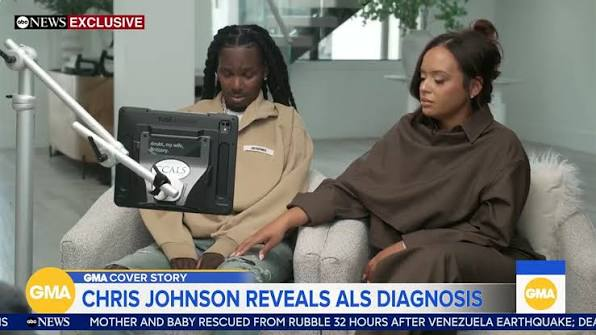
I don’t think we talk enough about that seat, the one next to the person who gets the diagnosis. There is a particular grief in being the one who carries on the lifting, the speaking-for, the small daily logistics of love, while quietly absorbing the loss of the person you knew in a different body. Brittany did not choose this role, and almost no caregiver does. It arrives unannounced and asks for everything at once, physically, mentally, and emotionally. So much of it is making sure a loved one’s needs are met, very often at the expense of the caregiver’s own rest, health, and grief. Caregiving asks for an extraordinary kind of presence, and it usually asks for it without applause.
What stays with me is how this happens to all of us, eventually, in some form. We watch the people we love move through the world fearlessly, and we let ourselves believe that their strength is permanent. Then a clinical diagnosis arrives, with its flat medical language, and reorders everything. The person is still entirely themselves. The love is still there. But the terms have changed, and they can’t be reverted or renegotiated.
Chris Johnson outran everyone for years. Now he’s showing us a different kind of power, the power to choose to fight, and to give back to family and community, even on the hardest day of his life. Still him. Still them. I wish Chris, Brittany, and their four children strength in the days ahead. Caregiving has become the center of their family now, the quiet, daily work of love that will hold them together, and they are already meeting it with more grace than most of us could imagine.
Sincerely,
Fatima K.
Manana Founder
If you’re navigating the challenge of caring for a loved one, or simply need reliable backup when life gets hectic, know that Manana is here to help.
Have questions? Call (615) 212-9609 or Send Us A Message